Jun 30, 2025
Where to Stay in Joshua Tree? How About... Not in Joshua Tree?
Every year, millions of people type the same three words into a search bar: "Airbnb Joshua Tree." They picture themselves in a glass-walled A-frame, cocktail in hand, watching the sun dissolve behind a ridge of granite boulders. And there is absolutely nothing wrong with that vision. But here is the thing most first-timers do not realize: the town of Joshua Tree itself is a thin strip of highway frontage along the Twentynine Palms Highway, and many of the most compelling places to stay in the region are not technically in Joshua Tree at all.
If you are planning a desert trip and want more space, more character, and a genuine sense of place, it is worth widening your search radius. The communities that ring Joshua Tree National Park each have their own personality, and several of them offer a better base camp than the town that shares the park's name. Here is the insider's guide to where to stay near Joshua Tree — from someone who chose to build a hospitality brand in one of these alternative neighborhoods.
The Joshua Tree Paradox
Joshua Tree, the town, benefits from extraordinary name recognition. That recognition also means higher nightly rates, denser clusters of short-term rentals, and a corridor that can feel surprisingly commercial during peak season. The grocery store is a small market. The gas stations are limited. And depending on where your rental sits along the highway, you may find yourself sandwiched between two other vacation properties with minimal buffer.
None of this makes Joshua Tree a bad place to stay. It simply means there are trade-offs that most booking platforms never surface. When you search "Yucca Valley Airbnb" or "Pioneertown vacation rental," you unlock a different tier of the desert experience — one with larger lots, quieter nights, and often a significantly lower price per square foot.
Pioneertown: The Western Film Set You Can Sleep In
Pioneertown was built in the 1940s as a living Old West movie set. Roy Rogers and Gene Autry filmed here. The original Mane Street still stands — a wooden-facade strip of frontier buildings that now houses a handful of shops, a pottery studio, and the legendary Pappy & Harriet's Pioneertown Palace. If you have not heard of Pappy's, imagine a roadhouse honky-tonk where Paul McCartney has played an unannounced set and where the mesquite-grilled tri-tip is reason enough to make the drive.
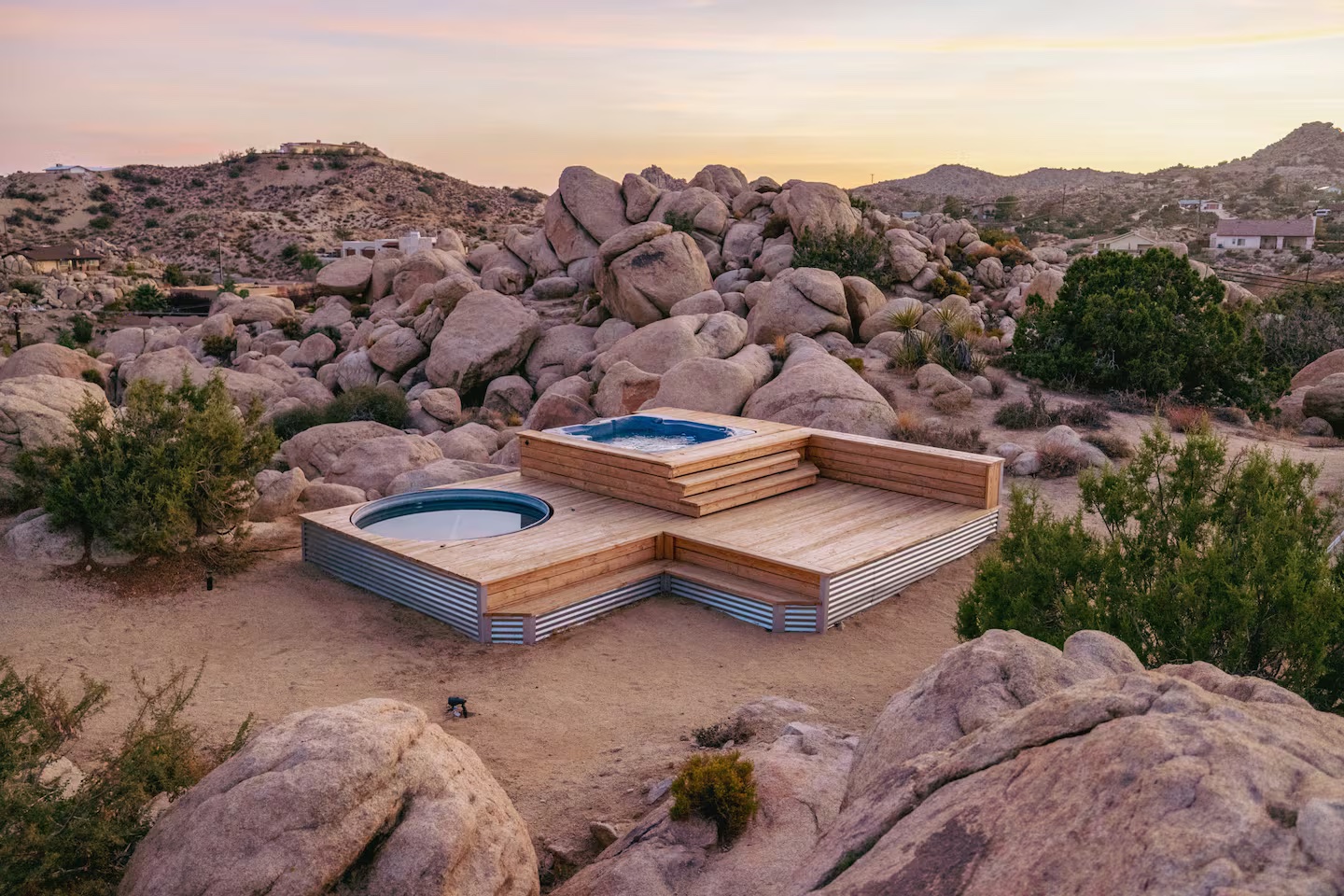
Staying in Pioneertown means waking up in genuine High Desert quiet, with wide-open views and a community that measures its full-time residents in the hundreds, not thousands. The west entrance of Joshua Tree National Park is roughly 20 minutes away via a scenic drive through the Yucca Valley corridor. Properties here tend to sit on larger parcels — one to five acres is common — which translates to real privacy and unobstructed night skies.
Yucca Valley: The Practical Choice That Doesn't Feel Practical
Yucca Valley is the largest town in the Morongo Basin and the one most visitors drive through without realizing what it offers. At roughly 3,300 feet of elevation, it sits several hundred feet higher than Joshua Tree, which means noticeably cooler temperatures in summer — a detail that matters more than you think when July afternoons push past 110 degrees at lower elevations.
The town has genuine infrastructure: a well-stocked supermarket, hardware stores, coffee roasters, a growing collection of vintage shops, and several excellent restaurants. For families or groups staying a week, the convenience of real errands within a five-minute drive is hard to overstate. Joshua Tree National Park's west entrance is about 15 minutes east along Highway 62, making it one of the closest alternatives to the town of Joshua Tree itself.
Yucca Valley also has a thriving creative community that operates largely below the tourist radar. Galleries, ceramics studios, and maker spaces dot the side streets. The vibe is less "curated desert aesthetic" and more "people actually live and work here," which, depending on what you are looking for, might be exactly the point.
Landers: For the Stargazers and the Solitude Seekers
North of Yucca Valley, the terrain opens into vast, flat expanses with almost nothing between you and the horizon. Landers is where you go when your primary goal is to disappear. Cell service is inconsistent. The nearest neighbor might be a quarter-mile away. And the night sky is among the darkest in Southern California, making it a legitimate destination for astrophotography and amateur astronomy.
The drive to Joshua Tree National Park from Landers takes approximately 25 to 30 minutes via Highway 247 and Highway 62. It is not the closest option, but the sense of total immersion in the landscape more than compensates. Landers is also home to the Integratron, a resonant acoustic chamber built on a supposed geomagnetic vortex — strange, singular, and worth experiencing at least once.
Properties in Landers tend to be the most affordable in the region, with nightly rates running well below comparable listings in Joshua Tree. If you are looking for a multi-night stay where the budget stretches further without sacrificing square footage or views, this is where to look.
Morongo Valley: The Desert Gateway
Sitting at the western edge of the Morongo Basin where Highway 62 climbs out of the San Gorgonio Pass, Morongo Valley is the first desert community most visitors encounter when driving from Los Angeles or Palm Springs. It is lower in elevation, warmer in winter, and significantly less expensive than anything further east along the highway.
The trade-off is distance: the park's west entrance is roughly 30 to 35 minutes from most Morongo Valley rentals. But for travelers who plan to split their time between Joshua Tree and the Palm Springs area, the location is actually ideal — you are roughly equidistant from both. The Big Morongo Canyon Preserve, a lush riparian oasis that feels wildly out of place in the desert, is a hidden gem right in town and rarely crowded.
Why the Best Desert Stays Are Not Where You Expect
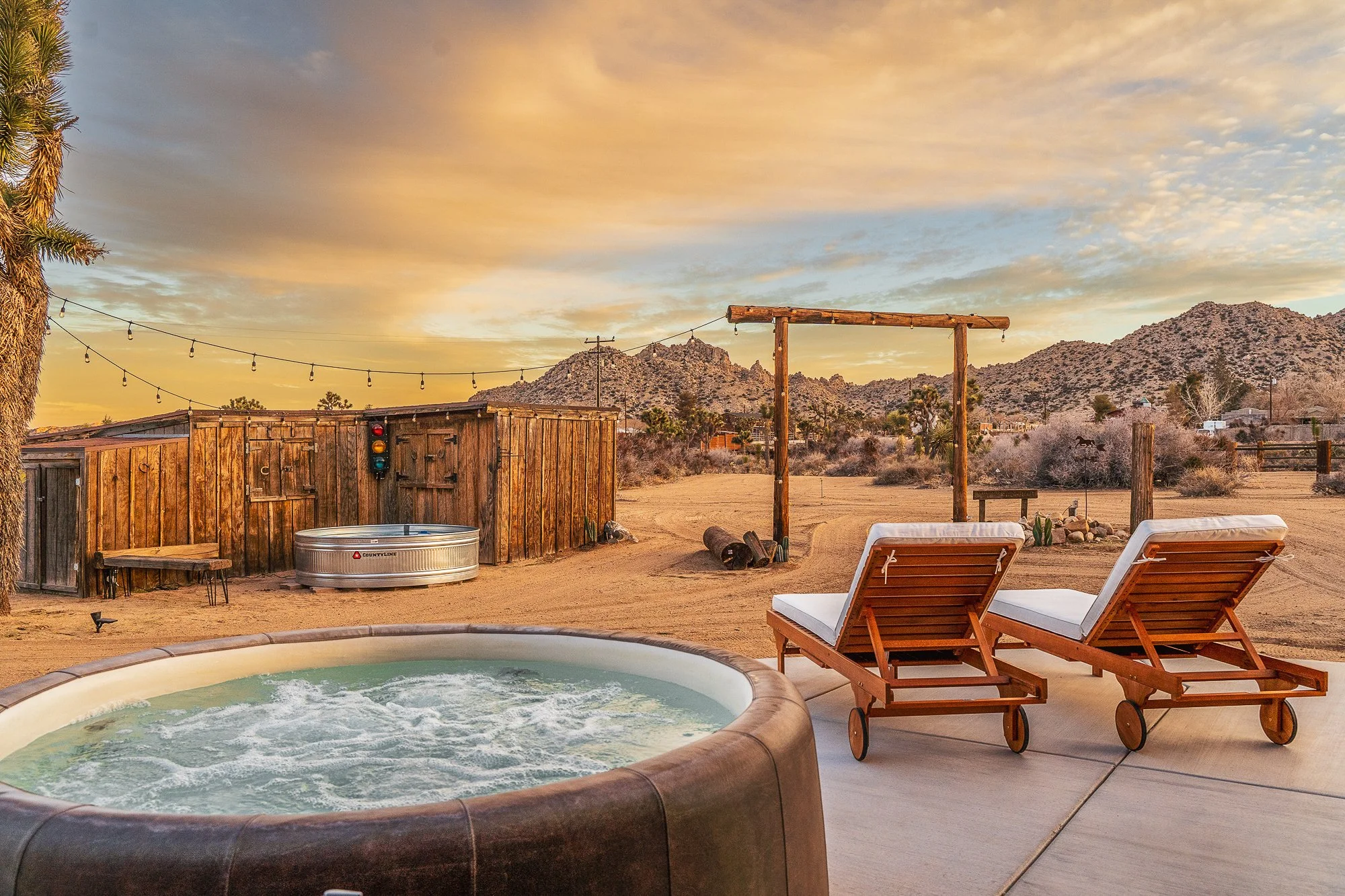
The pattern across all of these communities is consistent: when you step outside the Joshua Tree zip code, you gain space, privacy, and value. Properties on multi-acre lots with mountain views and hot tubs are available at rates that would buy you a modest cabin in town. The communities are quieter, the architecture is often more interesting (because owners have more room to build), and you get a genuine sense of what the High Desert is actually like as a place where people live — not just visit.
The national park is not going anywhere. Whether your rental is 10 minutes or 30 minutes from the entrance, the hikes are the same, the sunsets are the same, and the Joshua trees themselves could not care less where you slept the night before. What changes is everything around the park: the quality of your morning coffee ritual, the silence at midnight, the feeling that you found something the algorithm was not designed to show you.
Book Direct, Stay Better
At House Of, we build design-forward desert properties in the communities we believe in — starting with Pioneertown. If this kind of travel appeals to you, we would love to host you. Book direct at houseof.cc and skip the Airbnb fees. No booking fees, no algorithmic nonsense — just a beautiful place to stay and a team that actually lives out here.